
Crack Sealing, Chip Seal, or Slurry Seal: Choosing the Right Pavement Preservation Method
A road doesn’t fail overnight. It starts with a hairline crack. Then water gets in. Then freeze-thaw cycles, traffic loads, and oxidation take over, and a $2-per-square-foot preservation fix turns into a $10-per-square-foot rehabilitation project — or worse, full reconstruction.
The good news: most pavement distress is preventable if you catch it early and choose the right treatment. The challenge is that “pavement preservation” isn’t one thing — it’s a toolbox. Crack sealing, chip seal, and slurry seal all extend pavement life, but they solve different problems, at different stages, at different price points.
This guide breaks down each method, when to use it, and how to build a preservation program that keeps your roads out of the reconstruction pile.
Why Pavement Preservation Matters More Than Repair
Every road engineer knows the pavement condition curve: a road loses about 40% of its remaining life in the first 75% of its lifespan, then loses the remaining 60% of its value in the last 25% — fast. Preservation treatments are designed to catch pavement while it’s still in good-to-fair condition, when a thin, low-cost treatment can reset the clock.
Wait too long, and you’re no longer preserving — you’re rebuilding. That’s the case for treating preservation as a scheduled program, not a reactive one.
Crack Sealing: The First Line of Defense
What it is: Crack sealing involves routing out and filling individual cracks with a hot-applied sealant to prevent water intrusion. It’s the most targeted and least expensive of the three treatments.
Best for:
- Pavements in good structural condition with isolated transverse or longitudinal cracking
- Preventing water infiltration into the base and subgrade
- Extending the interval before a surface treatment is needed
Limitations: Crack sealing does nothing for surface friction, raveling, or widespread cracking (like alligator cracking). It’s a targeted fix, not a surface renewal.
Where the right materials matter: Crack sealing performance depends heavily on the sealant’s flexibility and adhesion. This is where an oxidized bitumen like 115/15 earns its place — it’s formulated specifically for crack filling, joint sealing, and similar industrial sealing applications, giving it the tack and durability needed to keep water out through repeated thermal cycling.
Chip Seal: Surface Protection with Structural Bonus
What it is: A chip seal is a sprayed application of asphalt binder followed immediately by an aggregate layer, rolled into place. It seals the surface against water and oxidation while adding skid resistance.
Best for:
- Roads showing early-stage raveling, oxidation, or minor surface cracking
- Rural and low-to-moderate volume roads where cost efficiency matters
- Renewing surface friction without the cost of an overlay
Limitations: Chip seals can temporarily reduce ride smoothness and require loose-chip sweeping after application. They’re not a fix for structural or load-related distress.
Where the right materials matter: The binder is the backbone of a chip seal’s performance. Paving-grade bitumen (60/70 or 85/100) provides the structural strength needed for high-traffic applications, while a coating bitumen like SS1/CSS1 works as the tack coat binding the surface course to the binder layer beneath — critical for chip retention and long-term bond strength. For roads needing a prime coat ahead of the binder course, MC70 coating bitumen prepares the base for proper adhesion.
Slurry Seal: The Smooth, Uniform Renewal
What it is: A slurry seal is a mixture of fine aggregate, emulsified asphalt, water, and additives, spread as a thin, uniform layer across the entire pavement surface.
Best for:
- Pavements with fine cracking, minor raveling, or oxidized surfaces but no structural issues
- Parking lots, urban streets, and airport aprons where a smooth, tight finish matters
- Sealing the surface while restoring a fresh, uniform appearance
Limitations: Like chip seal, slurry seal is a preservation treatment, not a structural repair — it won’t fix potholes, deep cracking, or base failures underneath.
Side-by-Side Comparison
Factor | Crack Sealing | Chip Seal | Slurry Seal |
Best pavement condition | Good, isolated cracking | Fair, early raveling/oxidation | Fair, fine cracking/oxidation |
Primary function | Waterproofing cracks | Surface seal + skid resistance | Surface seal + smooth finish |
Relative cost | Lowest | Low-moderate | Moderate |
Ride quality after treatment | Unchanged | Slightly rougher initially | Smooth, uniform |
Typical service life extension | 2–5 years | 5–7 years | 4–6 years |
Traffic volume suitability | Any | Low-to-moderate | Low-to-high, including urban |
What About the Potholes That Slipped Through?
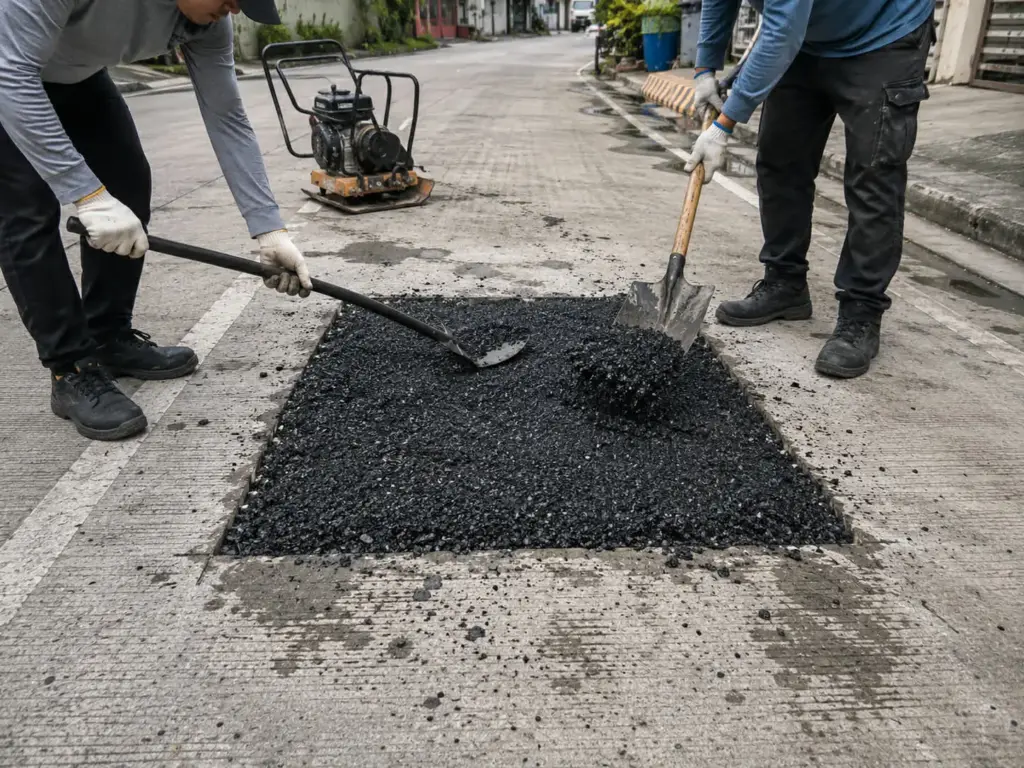
Even the best preservation program won’t catch everything. Utility cuts, storm damage, and neglected sections can produce potholes and trench cuts that need immediate structural repair before any surface treatment goes down. Sealing over an unrepaired pothole just traps the problem under a fresh layer.
For these situations, a ready-to-use repair material matters:
- InstaRepair — a heavy-duty, bag-ready asphalt patch built for potholes on busy roads, highways, and parking lots. The All-Weather version pushes standing water out of the way and bonds to wet potholes, with traffic-ready performance in as little as 15 minutes, handling depths from 10mm to 100mm. The Dry version is built for clean, dry potholes in sunny conditions, curing fully in 24 hours for depths of 20mm to 50mm.
- InstaPatch — a precision asphalt designed for the narrow trenches and utility cuts left behind after underground pipe, cable, or wire work. Like InstaRepair, it comes in All-Weather (immediate traffic-ready, wet-trench capable) and Dry (24-hour cure, planned dry-weather work) versions.
Repairing these defects first, then applying the appropriate preservation treatment, is what separates a pavement management program from a patchwork of quick fixes.
Building a Preservation Program That Works
- Survey and rate condition — identify which sections are candidates for crack sealing, chip seal, or slurry seal versus which need structural repair first.
- Repair before you seal — use InstaRepair or InstaPatch to address potholes and utility cuts before any surface treatment.
- Match the treatment to the distress — isolated cracking gets crack sealant; oxidized or raveling surfaces get chip seal or slurry seal.
- Use the right binder for the job — 60/70 or 85/100 paving bitumen for structural strength, SS1/CSS1 or MC70 for tack and prime coats, and 115/15 oxidized bitumen for crack and joint sealing.
- Re-treat on schedule — preservation isn’t a one-time fix. Budgeting for treatment cycles every 5–7 years keeps roads from sliding down the condition curve into costly rehabilitation.
The Bottom Line
Crack sealing, chip seal, and slurry seal aren’t competing methods — they’re complementary tools that address pavement at different stages of distress. The real cost savings come from applying the right treatment at the right time, backed by materials engineered for the job: structural-grade paving bitumen, reliable tack and prime coats, purpose-built crack sealant, and fast, dependable pothole and trench repair products for the damage that can’t wait.
A well-timed preservation program doesn’t just save money — it keeps roads safer and construction crews off busy streets more often than reactive repair ever could.